
How we made a one-take storm shot with AI (every prompt included)
A woman playing a grand piano on the bow of an ocean liner in a storm. One continuous FPV drone move: dive, orbit, profile, a pass along the keys under her fingers, and a pull-up to the aerial. Planned in Mad Genius PREVIS, rendered with Seedance 2.5.
A text prompt can describe a camera move. It can't hold one. Ask a video model for "an FPV drone dives in, orbits her, skims the keys and pulls up" and you get a guess: a cut where you wanted an orbit, a skipped beat, a different ship halfway through. The way round it is the oldest trick in film: previs. Block the shot out in grey 3D, plan the camera, and hand the video model a reference clip so it follows the move instead of inventing one.
This post is the whole pipeline for this shot, step by step, with every prompt exactly as we used it.
Tools: Mad Genius PREVIS (blockout and camera, free during the open beta), Claude (builds the scene over MCP), Seedream 5 Pro (character sheet), Nano Banana 2 (photoreal keyframes), Seedance 2.5 (the video). The image and video models were run on Magnific.
Step 0. Connect Claude to PREVIS
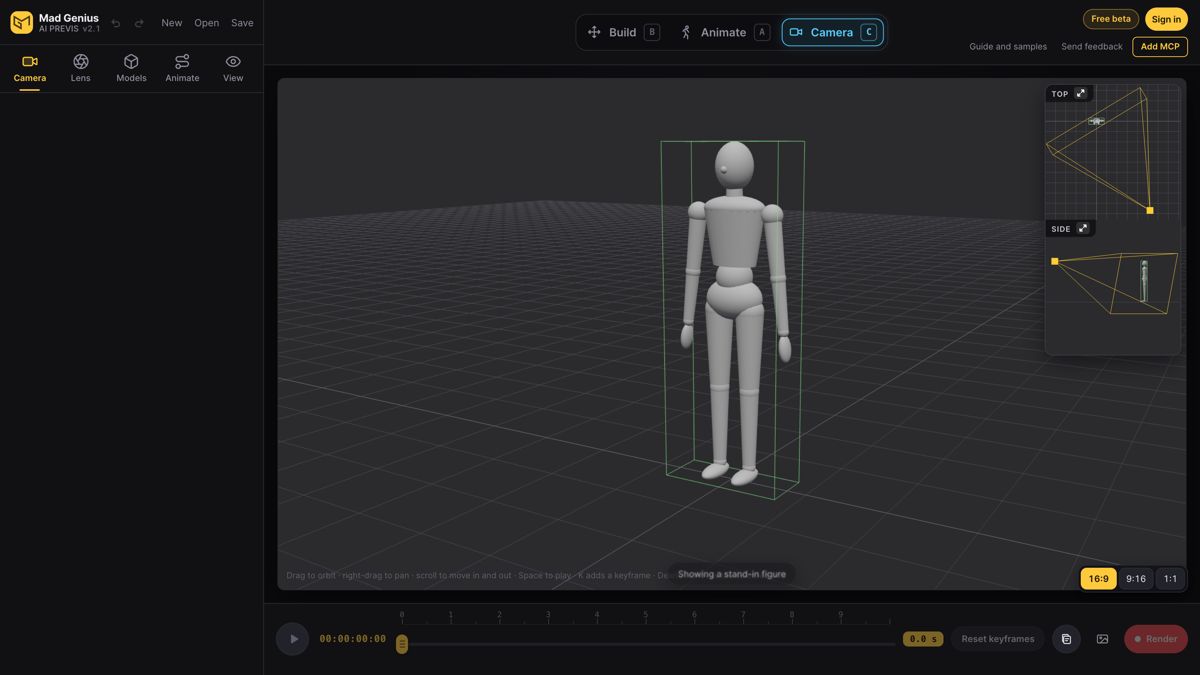
- Open the app at madgeniusprevis.com/app and sign in.
- Press Add MCP (top right) and copy your private link.
- In Claude, add it as a custom connector. Claude now has the PREVIS tools:
get_scene,list_shapes,build_scene,edit_scene,look,save_frame,render_videoandshot_prompt.
Keep the PREVIS tab open. Claude builds in it while you watch.
Step 1. Describe the shot, Claude builds the blockout
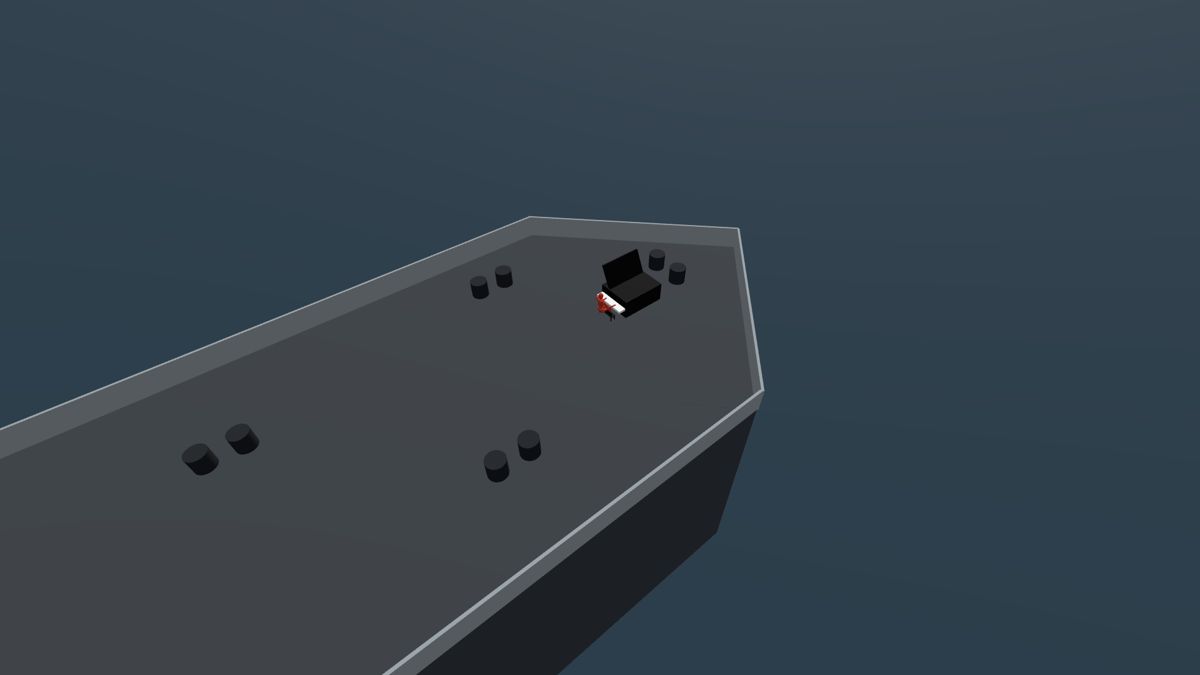
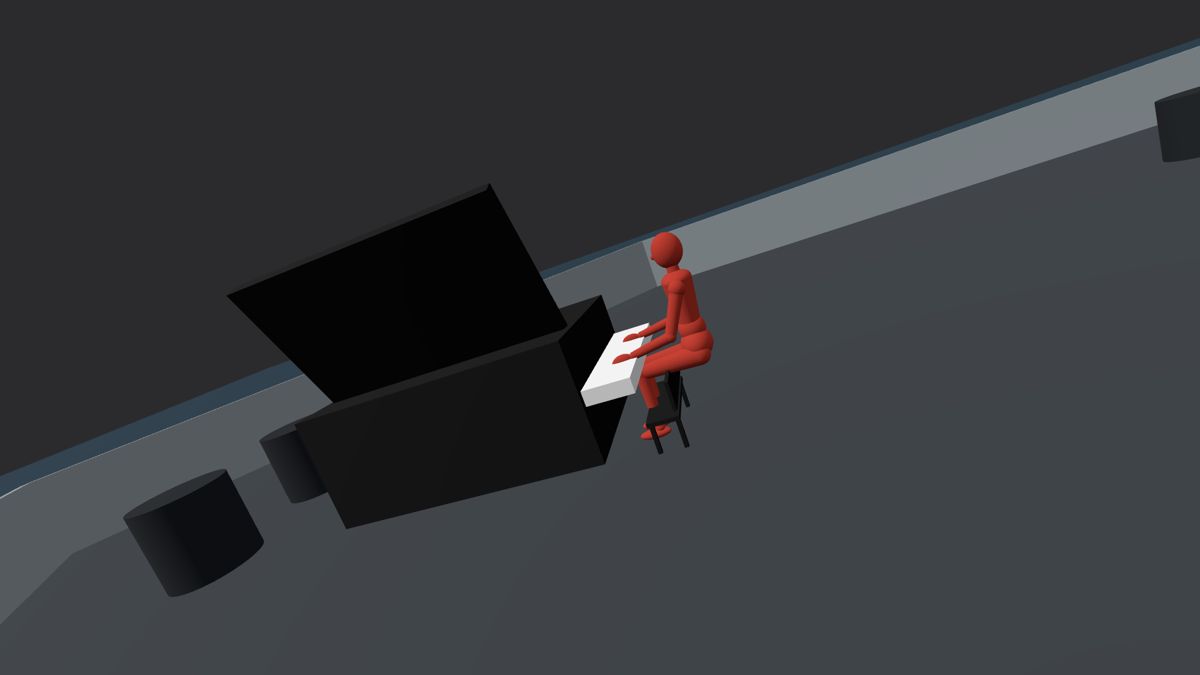
Tell Claude what the shot is. Ours was, in short: the bow of an ocean liner in a storm, a grand piano near the tip, a woman playing it. Claude calls build_scene to lay out the deck, the railings, the bollards, a black box for the piano and a red mannequin at the keys, checks its work with look, and fixes what's off with edit_scene.
It's deliberately crude. Grey slabs and boxes are enough: what matters is the layout, the scale and the camera.
Step 2. Direct the camera
One FPV move on Cam B, 15 seconds, keyframed in the app:
| Time | Move |
|---|---|
| 0–2.2 s | Dive from a high aerial down behind her left shoulder |
| 2.2–8 s | Fast low orbit around her and the piano, banking |
| 8–9 s | Level out on her side profile at eye level |
| 9–11.5 s | Skim along the keyboard, under her fingers |
| 11.5–15 s | Whip round, climb over the rail and pull back to the aerial |
Step 3. Save a frame at each key moment
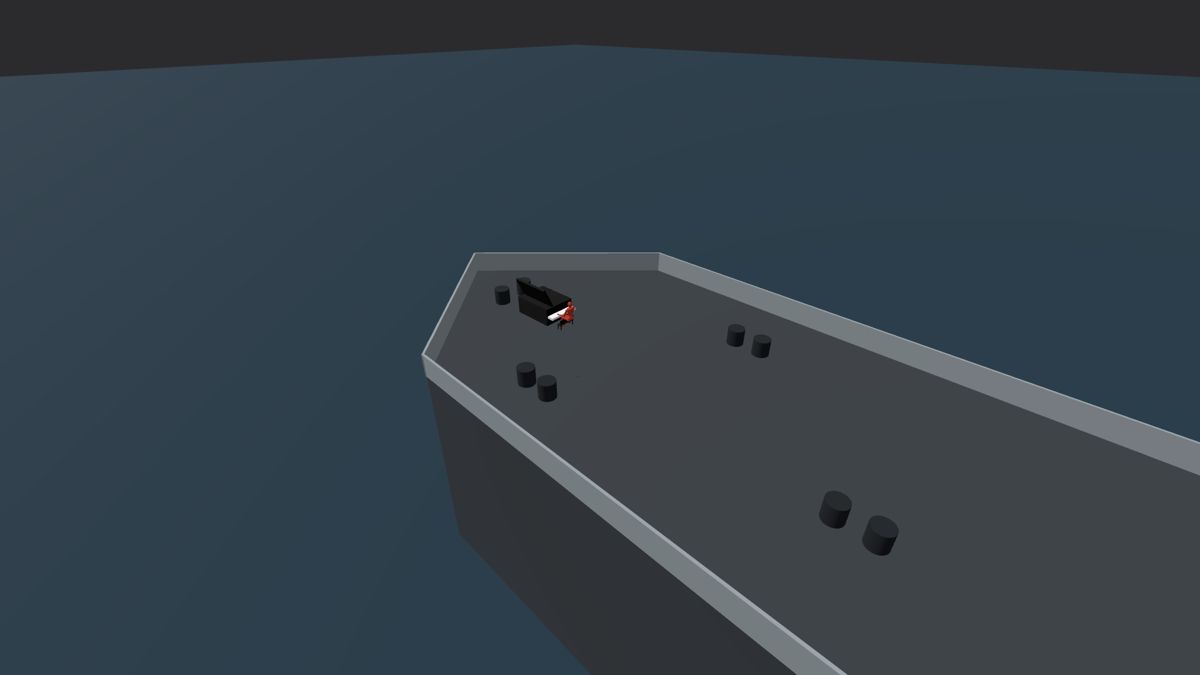
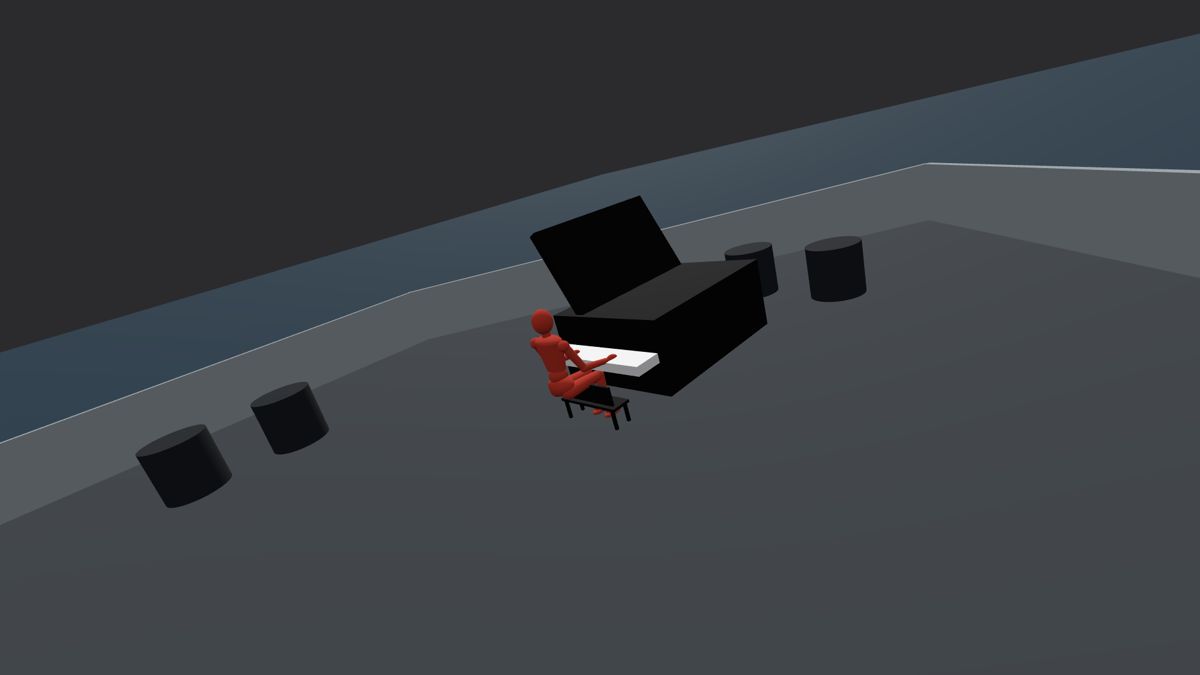
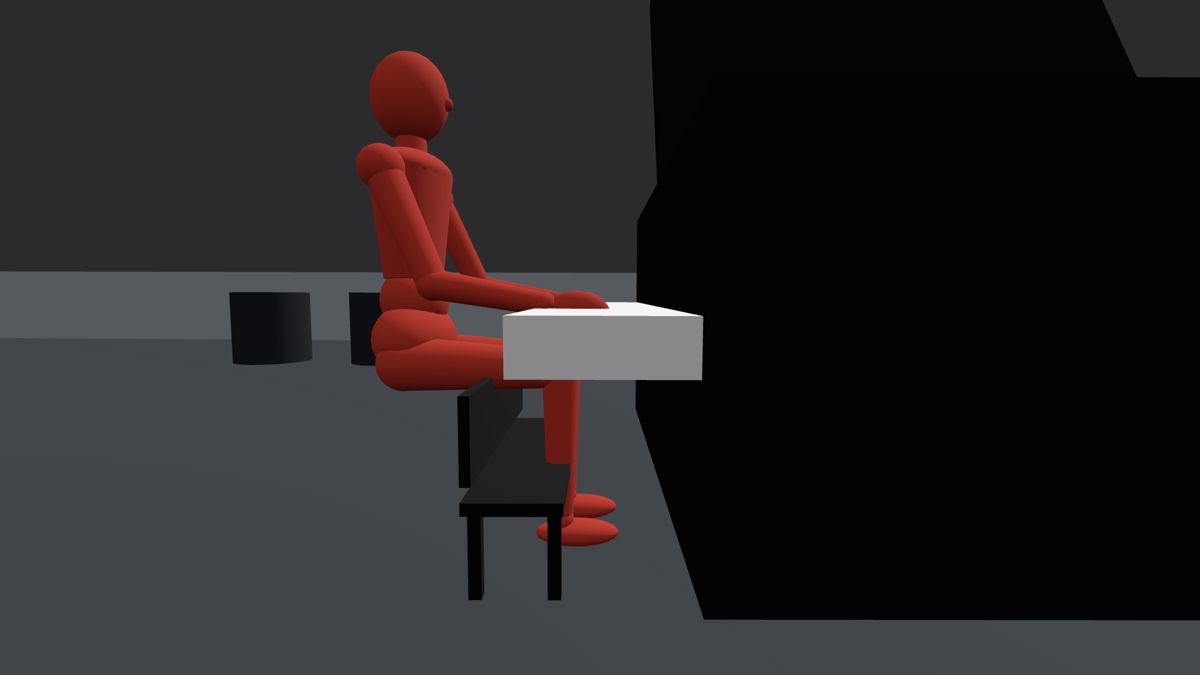
Press Save frame at the beats you'll want as keyframes. We saved five: 0 s (the opening wide), 2.2 s (behind her shoulder), 4.6 s (the low Dutch angle), 8.4 s (her profile) and 15 s (the closing aerial).
Step 4. Make a character sheet
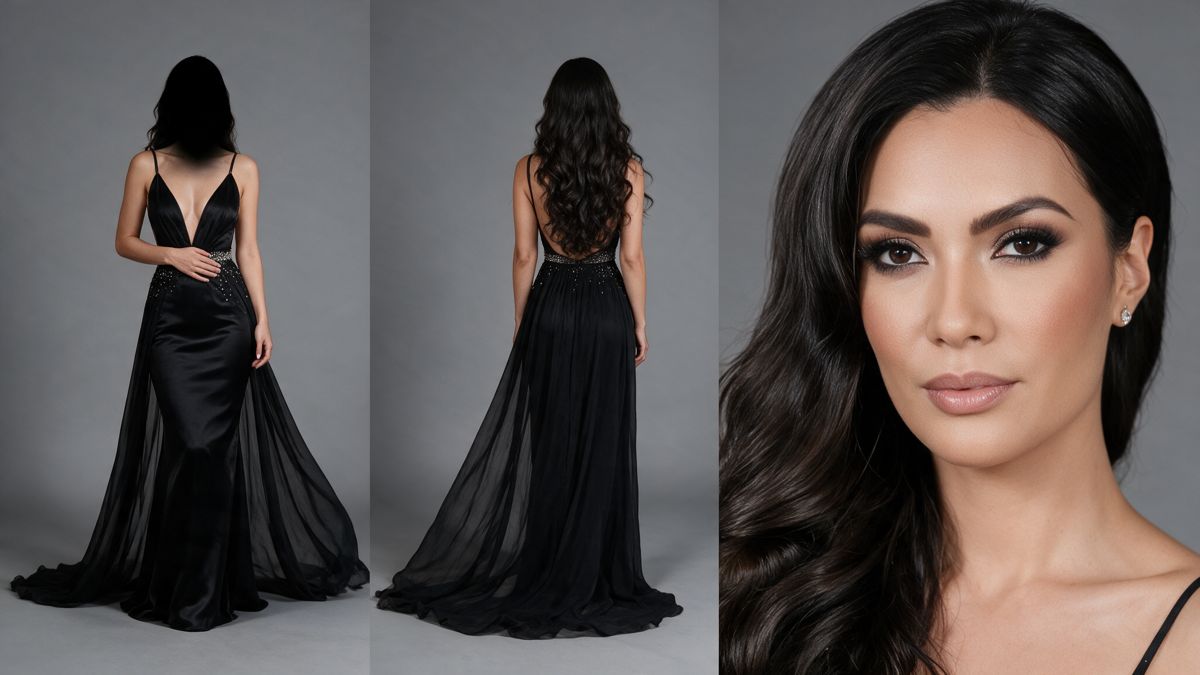
So she looks the same in every shot, we made a turnaround sheet first: front, back and a face close-up. Seedream 5 Pro (we also tried GPT 2.5), with a photo of the woman we wanted as the reference. Here's the prompt exactly as we ran it, placeholders and all: the reference photo filled them in.
**Professional character reference turnaround sheet, 3-panel split triptych composition on solid neutral studio gray background. use the black dress for the full body**
**[LEFT PANEL]:**Front-facing body view of the lady  wearing [Clothing Details], [Accessory Details],**the head and face are completely omitted and replaced by a solid black silhouette shape**, emphasizing casual posture and clothing drape.
**[CENTER PANEL]:**Back-facing body view showing [Details of Back/Hair/Shoulders] and [Posture Details], with the subject facing away from the camera.
**[RIGHT PANEL]:**Large detailed close-up portrait headshot of [Subject Name], [Facial Features], [Expression/Mood], [Eye Contact Style], neutral studio lighting, 85mm portrait lens, shallow depth of field.
**Clean studio lighting, ultra-high resolution, photorealistic, no text, no watermarks, no labels.**
Step 5. Turn each blockout frame into a photoreal keyframe
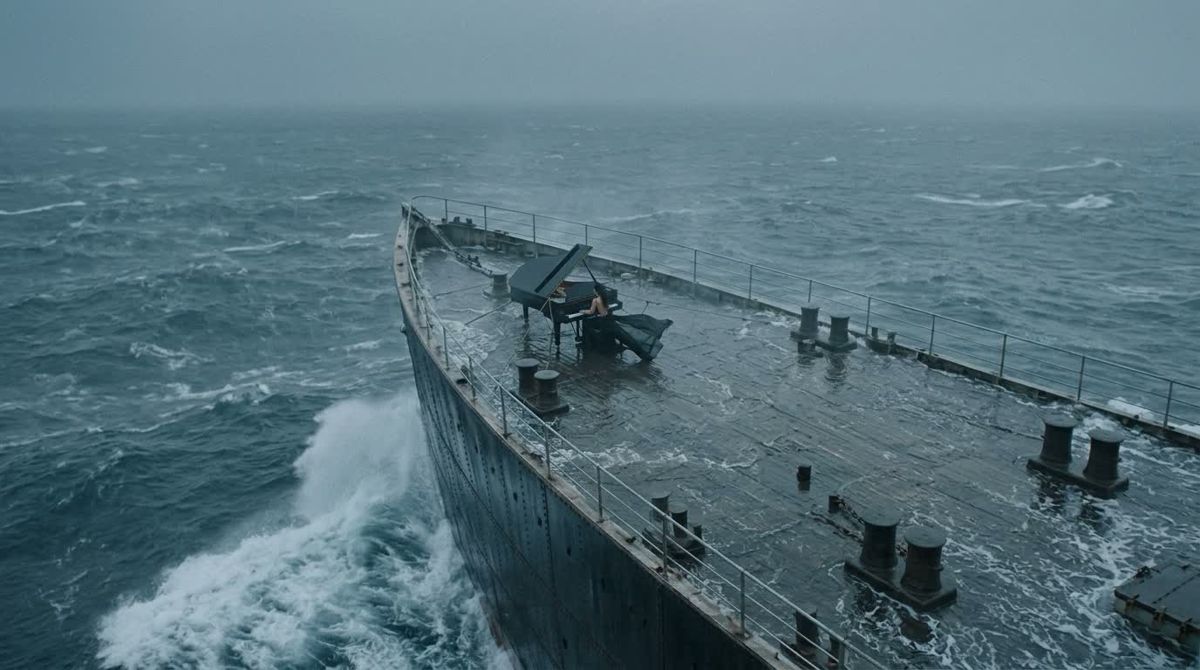
This is the step that makes it work. Each keyframe is made with Nano Banana 2 from three things: the blockout frame (for the camera and framing only), the character sheet (for her), and the previous photoreal shot (so the ship, the light and the storm carry over). The prompts spell out what every grey shape stands for, and where things sit in the frame in percentages.
The wide frame (the first one, from the blockout alone)
Use the grey 3D blockout render ONLY for the camera: the camera position, height, angle, lens, framing, and where and how big the piano and the woman are in the frame. Do NOT copy the shapes of the blockout. Its boxy, flat, coffin-shaped slab is only a rough placeholder for a real ship, and the box with a flap is only a placeholder for a real piano. Replace them with real, correctly shaped objects.

CAMERA AND FRAMING (from the blockout, keep this exactly):
- High-angle aerial drone view looking down at about 40°, from far above and behind the port side of the ship. NO horizon and NO sky: open stormy ocean fills the entire background to the top edge.
- The ship's foredeck enters from the bottom-left of the frame and runs up and to the right, toward the bow in the upper right. Open ocean is above and to the right of the ship.
- The grand piano sits on the foredeck near the bow, in the upper right of the frame at about 67% from the left and 33% from the top. It is SMALL: about 5% of the frame width.
- The woman sits at the keyboard on the piano's near-left side, at about 64% / 36%. She is TINY: about 4% of the frame height, no bigger than the red figure in the blockout.
- Most of the frame is wet steel deck and ocean. The woman and the piano are a small detail in a vast scene.

THE REAL SHIP (do not copy the blockout's shape): the bow of a real early-20th-century ocean liner, like a classic transatlantic steamship. A long foredeck that tapers gracefully to a sharp, curved, raked prow with a gentle upward sheer; a tall, flared, riveted black steel hull plunging into the sea, bow wave and spray where it cuts the water; thin iron railings with stanchions running along both sides and converging at the prow; wet, weathered riveted steel deck plating; iron mooring bollards in pairs, anchor chains and hatch covers on the deck.

THE REAL PIANO: an elegant black concert grand piano with its curved body, three legs and its lid propped open, lashed to the deck with ropes.

THE WOMAN: use the photo of the woman for her face, long dark wavy hair and figure. She is the only person in the frame, seated at the piano, playing. A long flowing black chiffon gown; the skirt spills off the bench and the train streams across the wet deck in the wind, her hair blowing sideways. At this distance she reads as a small dark silhouette with a hint of sparkle.

LOOK: violent storm, dark churning ocean with whitecaps all around the ship, waves breaking over the rail and white seawater rushing across the deck, heavy mist and sea spray, overcast diffused daylight, desaturated steel-blue and slate-grey colour grade. If a photo of the ship in the storm is provided, use it for this look and for the real ship's design, never for its camera angle, framing or people.

No grey blockout shapes, no flat slabs, no boxy forms, no CG look, no floor grid.

Shot on ARRI Alexa 65 with a Panavision Sphero 65 lens, 30mm, deep focus, fine film grain, photoreal, 16:9.
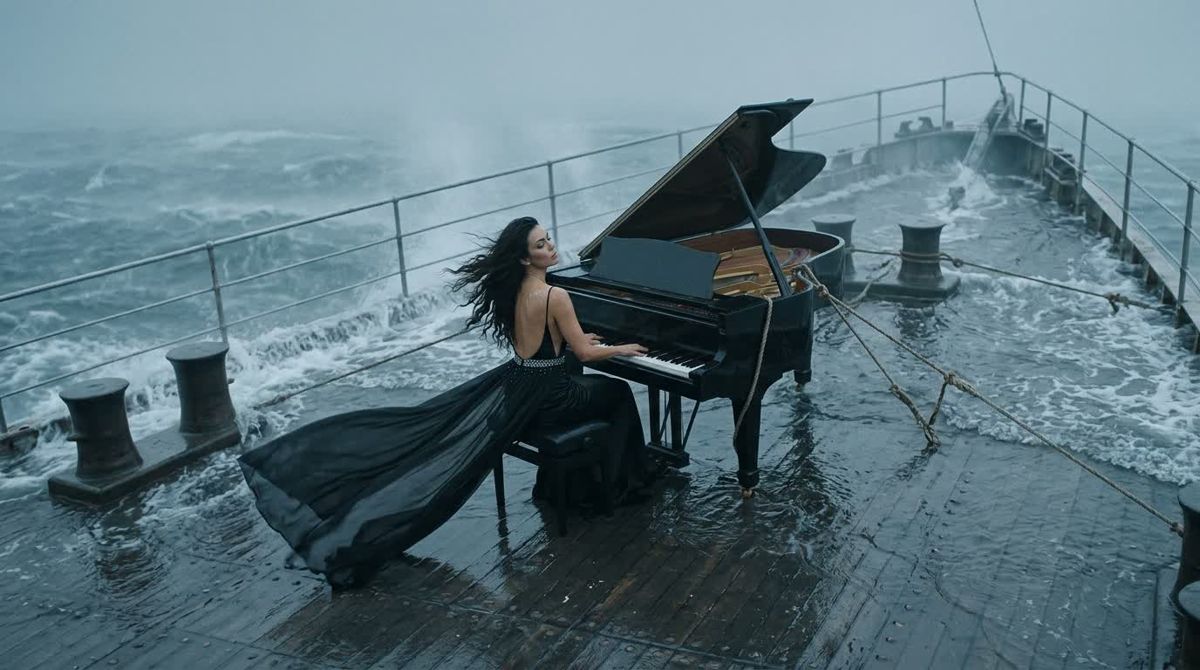
Shot 2: behind her shoulder
SHOT 2 of the same scene. Three references: the WIDE FRAME (the photoreal aerial of the woman playing the grand piano on the bow of the liner in the storm), the CHARACTER SHEET (the woman in the black gown, front, back and face close-up) and the 3D PREVIS (grey blockout with a red mannequin at a black box piano).

CAMERA AND FRAMING come from the 3D PREVIS only. Use it for the camera position, height, angle, lens, framing, and where and how big the woman and the piano are. Do NOT copy its boxy shapes: the grey slab is the ship's deck, the grey strip with a thin line is the railing, the dark cylinders are iron bollards, the black box with the raised flap is the grand piano, the white bar is its keyboard and the red mannequin is the woman.
- Medium-wide shot from a moderate high angle, about 25° down, from behind and to the left of the woman, looking across the foredeck toward the starboard rail and the bow.
- The woman sits at the keyboard just left of centre, at about 47% from the left and 53% from the top, seen from behind in three-quarter view with her face turned slightly toward the keys. She is about 16% of the frame height.
- The grand piano is just right of centre at about 54% / 44%, about 20% of the frame width, its lid propped open toward the upper left.
- The ship's railing runs diagonally across the upper part of the frame, from the left edge at about 65% height up to the right edge at about 25%, meeting the bow corner in the upper right. Beyond the railing: the raging stormy ocean and misty sky, no clear horizon.
- A pair of iron bollards in the left foreground (about 15% / 69% and 24% / 62%) and a pair behind the piano on the right (about 63% / 40% and 70% / 40%).
- The lower half of the frame is wet steel deck.

WORLD AND LOOK come from the WIDE FRAME. This is the same moment, ship, piano, sea and weather, seen closer: the same early-20th-century liner bow with its weathered, riveted wet steel deck, thin iron railings and stanchions, iron bollards and ropes lashing the black concert grand piano to the deck; the same violent storm, white seawater rushing across the deck, waves breaking over the rail, heavy mist and spray, overcast diffused daylight and the same desaturated steel-blue and slate-grey grade.

THE WOMAN comes from the CHARACTER SHEET: her exact face, makeup, long dark wavy hair and figure, and the exact gown: a black satin gown with thin straps, a deep plunging V neckline, an open back, a crystal-beaded waistband with scattered sparkle below it, and long sheer black chiffon overlay panels and train. She is the only person in the frame, seated at the piano, playing, hands on the keys, head tilted slightly back, eyes half-closed. The gale catches the sheer chiffon train and streams it across the wet deck behind her, and her hair whips sideways. Wet skin glistening with spray.

No grey blockout shapes, no boxy forms, no mannequin, no CG look. Exactly one person.

Shot on ARRI Alexa 65 with a Panavision Sphero 65 lens, 35mm, T2.8, fine film grain, photoreal, 16:9.
Shot 3: the low Dutch angle
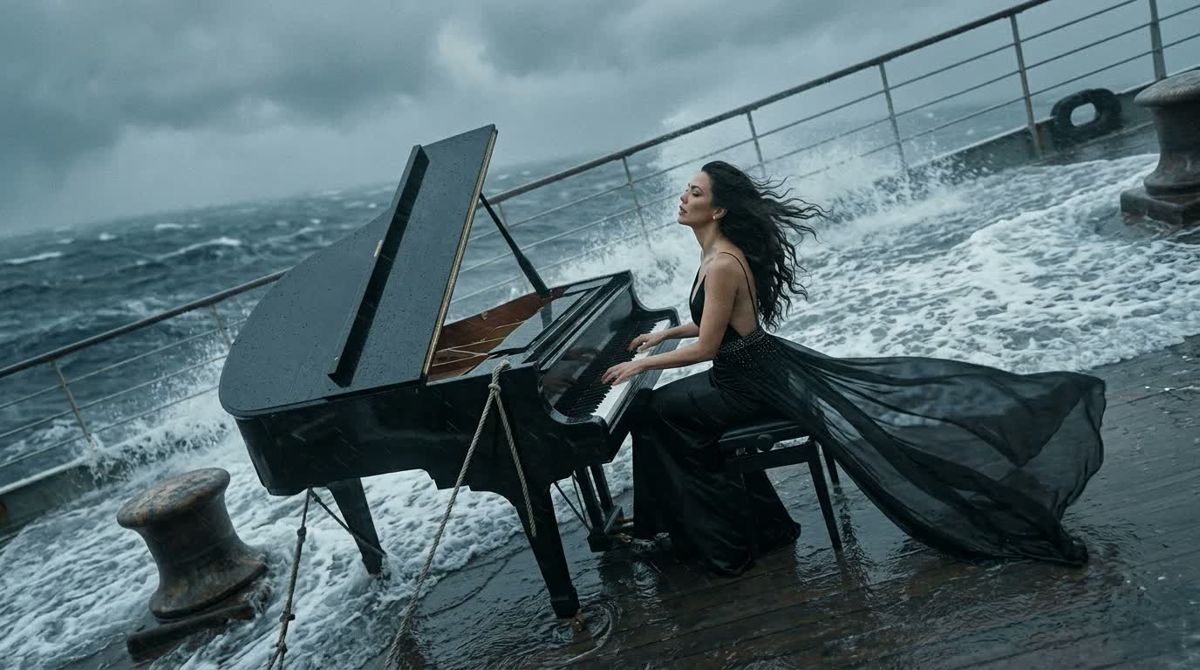
SHOT 3 of the same scene. Three references: SHOT 2 (the photoreal frame of the woman playing the black grand piano on the storm-lashed deck of the liner), the CHARACTER SHEET (the woman in the black gown: front, back and face close-up) and the 3D PREVIS (grey blockout with a red mannequin seated at a black box piano, strongly tilted).

CAMERA: Shot on an ARRI Alexa 65 large-format cinema camera with a Panavision Sphero 65 50mm prime lens at T2. Handheld camera position on the woman's LEFT side, slightly in front of her, about 2.5 metres away, lens a little above her shoulder height (about 1.6 m) tilted slightly down, rolled into a 20° Dutch angle. Focus on her face and hands; the piano's far end and the sea beyond fall softly out of focus. ARRI LogC with a desaturated steel-blue film grade, 24 fps, 180° shutter, fine film grain. Medium shot, 16:9.

FRAMING comes from the 3D PREVIS only: the strong tilt of the horizon, and where and how big the woman and the piano are. Do NOT copy its boxy shapes: the grey slab is the wet deck, the grey strip with a thin line is the ship's railing, the dark cylinders are iron bollards, the black box with the raised flap is the grand piano, the white bar is its keyboard and the red mannequin is the woman.
- We see her LEFT profile and her left arm, shoulder and the left side of her face.
- The railing runs as a steep diagonal from the left edge at about 75% height up to the top-right corner at about 8%. Beyond the railing, in the upper left, the raging dark sea and storm sky.
- The grand piano fills the left-centre of the frame, from about 19% to 52% across and 27% to 78% down, seen from its keyboard end and side, its lid propped wide open toward the upper left.
- The woman sits at the keyboard right of centre, at about 55% from the left and 50% from the top, facing screen-left toward the keys, both hands on the keyboard, her left side turned to camera. She is about 31% of the frame height, from her head to her feet on the bench.
- Two large iron bollards in the left foreground at the bottom-left (about 16% / 80% and 25% / 70%), and one cut off at the top-right edge.
- The lower right of the frame is wet steel deck with seawater running across it.

WORLD AND LOOK come from SHOT 2: the same ship, the same black concert grand lashed to the deck with ropes, the same weathered, riveted wet deck and thin iron railings, the same violent storm, waves breaking over the rail, white seawater rushing across the deck, heavy mist and spray, overcast diffused daylight and the same desaturated steel-blue and slate-grey grade. It must cut seamlessly with SHOT 2.

THE WOMAN comes from the CHARACTER SHEET: her exact face and makeup, seen in left profile, long dark wavy hair, and the exact gown: black satin with thin straps, a deep plunging V neckline, an open back, a crystal-beaded waistband with scattered sparkle, and long sheer black chiffon overlay panels and train. She plays with passion, eyes closed, head tilted slightly back, lips parted. The gale whips her hair back off her face and streams the sheer chiffon train across the wet deck behind her. Spray glistens on her shoulders and arms.

No grey blockout shapes, no boxy forms, no mannequin, no CG look. Exactly one person. Photoreal.
Shot 4: her profile
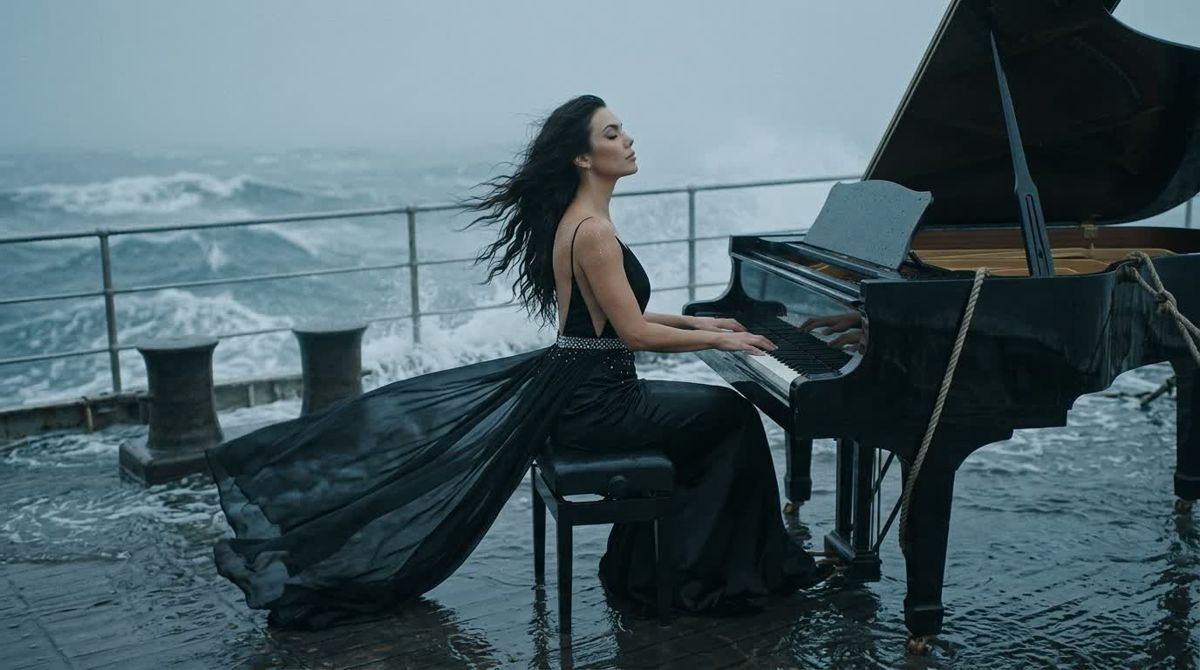
SHOT 4 of the same scene. Three references: SHOT 2 (the photoreal frame of the woman playing the black grand piano on the storm-lashed deck of the liner), the CHARACTER SHEET (the woman in the black gown: front, back and face close-up) and the 3D PREVIS (grey blockout of a red mannequin seated at a black box piano, seen from the side).

CAMERA: Shot on an ARRI Alexa 65 large-format cinema camera with a Panavision Sphero 65 40mm prime lens at T2. Camera on a tripod at her eye level (about 1.3 m, the height of a seated woman's head), perpendicular to her, about 3 metres away, horizon perfectly level, no tilt, no Dutch angle. A clean side-on profile composition. Focus on her face and hands; the background sea falls softly out of focus. ARRI LogC with a desaturated steel-blue film grade, 24 fps, 180° shutter, fine film grain. Medium-full shot, 16:9.

FRAMING comes from the 3D PREVIS only: where and how big the woman, the keyboard and the piano are. Do NOT copy its boxy shapes: the grey slab is the wet deck, the light grey strip is the ship's railing, the dark cylinders are iron bollards, the big black shape is the grand piano, the white bar is its keyboard and the red mannequin is the woman.
- She sits on the piano bench in pure side profile, facing screen-RIGHT toward the keys, her right side turned to camera. She fills most of the frame height, from her head near the top edge at about 7% down to her feet on the deck at about 81%, centred at about 36% from the left.
- The keyboard is directly in front of her, at about 42–59% across and 45–56% down, both her hands resting on the keys.
- The black body of the grand piano is very close and fills the right half of the frame, from about 53% to the right edge, its lid rising off the top of frame. Its glossy black surface reflects the grey sky and spray.
- Behind her, the ship's railing runs dead level across the left half of the frame at about 40–50% height, with two iron bollards just in front of it at about 22% and 30% across. Above the railing, the storm sea and misty sky.
- The lower part of the frame is wet steel deck with seawater running across it under the bench.

WORLD AND LOOK come from SHOT 2: the same ship, the same black concert grand lashed to the deck with ropes, the same piano bench, the same weathered, riveted wet deck and thin iron railings, the same violent storm, waves breaking over the rail, white seawater rushing across the deck, heavy mist and spray, overcast diffused daylight and the same desaturated steel-blue and slate-grey grade. It must cut seamlessly with SHOT 2.

THE WOMAN comes from the CHARACTER SHEET: her exact face and makeup seen in profile, long dark wavy hair, and the exact gown: black satin with thin straps, a deep plunging V neckline, an open back, a crystal-beaded waistband with scattered sparkle, and long sheer black chiffon overlay panels and train. Upright, elegant posture, chin lifted, eyes closed, lost in the music. The gale blows her hair back off her face behind her and lifts the sheer chiffon of the skirt and train, streaming it out behind the bench to the left. Spray glistens on her bare shoulders and arms.

No grey blockout shapes, no boxy forms, no mannequin, no CG look. Exactly one person. Photoreal.
The last frame: the closing aerial
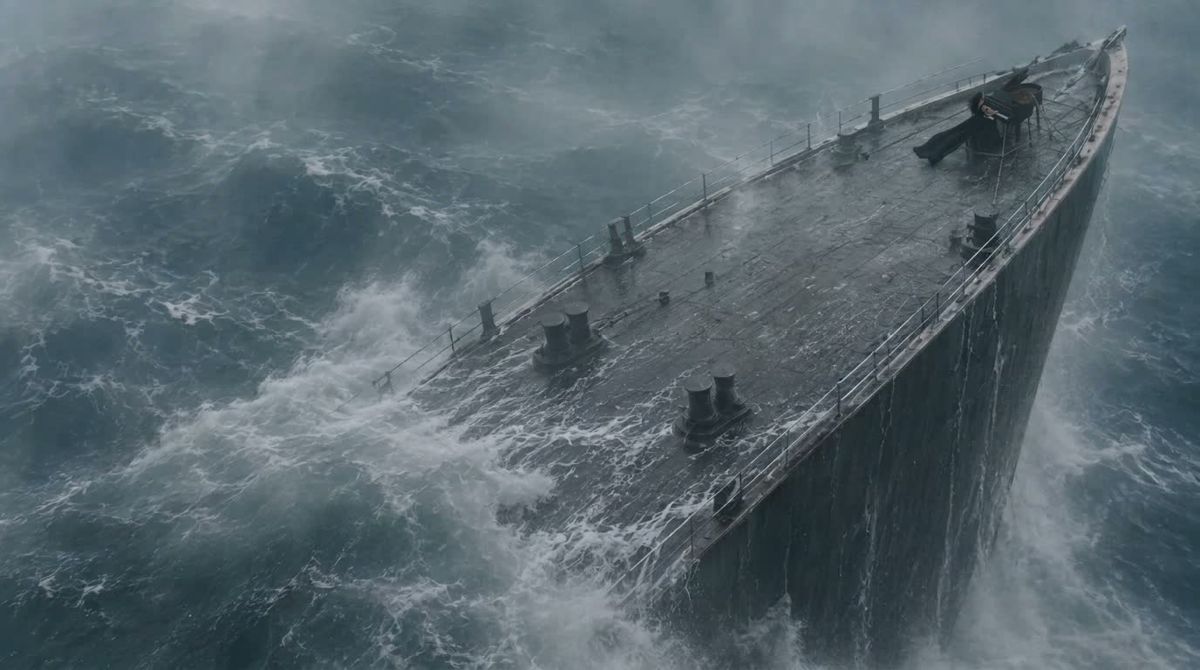
LAST FRAME of the same scene: the closing wide aerial. References: the WIDE FRAME (the photoreal aerial of the woman at the grand piano on the liner's bow in the storm), SHOT 2 (the closer photoreal frame of her playing on the storm-lashed deck) and the 3D PREVIS (grey blockout of the ship's bow seen from high above, a tiny red mannequin at a black box piano).

CAMERA: Shot on an ARRI Alexa 65 large-format cinema camera with a Panavision Sphero 65 35mm prime lens at T5.6, mounted on a heavy-lift cinema drone. High aerial about 40 metres above the deck, off the LEFT side of the ship and behind the piano, looking down at about 35° forward along the ship toward the bow, horizon level. Deep focus, everything sharp from the near deck to the horizon. ARRI LogC with a desaturated steel-blue film grade, 24 fps, 180° shutter, fine film grain. Extreme wide shot, 16:9.

FRAMING comes from the 3D PREVIS only: camera position, height, angle, and where and how big the ship, the piano and the woman are. Do NOT copy its boxy shapes: the coffin-shaped grey slab is only a placeholder for the real liner's foredeck, the grey edges are its railings, the dark cylinders are iron bollards, the black box is the grand piano and the red mannequin is the woman.
- A storm horizon runs level across the top of the frame at about 10% from the top, with heavy, dark, misty storm sky above it. Below it, a vast churning ocean fills most of the frame.
- The ship's foredeck enters from the bottom-right corner and runs diagonally up and to the left, toward the bow, which points to the upper left with its tip at about 35–40% across and 37–53% down.
- The far railing runs from the bow at about 55% / 37% to the right edge at about 66% height. The near railing runs from the bow tip at about 35% / 53% down to the bottom edge at about 67% across. Below the near railing, on the lower left, the tall dark hull plunges into the sea with a white bow wave.
- The grand piano sits on the foredeck near the bow at about 45% / 44%. It is SMALL: about 4–5% of the frame width.
- The woman sits at the keyboard on the near side of the piano at about 47% / 46%. She is TINY: about 4% of the frame height.
- Pairs of iron bollards at about 42% / 44% (near the piano), 62% / 50%, 45% / 56% and 72% / 77% (largest, nearest camera).
- Most of the frame is ocean and empty wet deck. She is a small, lonely detail in a vast storm.

THE REAL SHIP (do not copy the blockout's shape): the same early-20th-century ocean liner as in the WIDE FRAME: a long foredeck tapering to a sharp, curved, raked prow, a tall flared riveted black steel hull, thin iron railings converging at the prow, wet weathered riveted deck plating, iron bollards in pairs, anchor chains and hatch covers.

WORLD AND LOOK come from the WIDE FRAME and SHOT 2: the same black concert grand lashed to the deck with ropes, the same woman in the black gown with its long sheer chiffon train streaming across the deck in the wind, the same violent storm, waves breaking over the rail and white seawater rushing across the deck, heavy mist and sea spray, overcast diffused daylight and the same desaturated steel-blue and slate-grey grade.

No grey blockout shapes, no flat slabs, no boxy forms, no mannequin, no CG look. Exactly one person. Photoreal.
Step 6. Render the reference and generate in Seedance 2.5
Back in PREVIS, press Render the scene for the reference MP4, and Copy shot prompt for the camera move in words. Then in Seedance 2.5 (Pro, 15 s, 16:9, sound on), give it four references, each with one job:
| Reference | What it is | Its one job |
|---|---|---|
| @vid1 | The Cam B blockout clip | The camera only: path, speed, timing |
| @img1 | The character sheet | Her face, hair and gown |
| @img2 | The close-up keyframe | The look up close: piano, deck, spray, light |
| @img3 | The aerial keyframe | The look from above: the ship, the sea, the scale |
The full video prompt:
THE LAST RECITAL – FPV

Create a photorealistic 15-second horizontal 16:9 cinematic video filmed as ONE continuous FPV drone take, no cuts. Exactly ONE woman, playing a black grand piano on the bow of an ocean liner in a violent storm.

REFERENCES , EACH HAS ONE JOB:
@vid1 is the CAMERA ONLY: match its camera path, speed, timing and how close the camera gets to her at each moment. Take nothing else from it: it is a grey blockout, so ignore its shapes, colours and mannequin.
@img1 is the WOMAN ONLY: her exact face, makeup, skin tone, long dark wavy hair and figure, and her exact gown. Her identity comes from @img1 and nowhere else. Keep her identical to @img1 in every frame.
@img2 is the CLOSE-UP LOOK: how the piano, the bench, the ropes, the wet deck, the railing, the bollards, the spray and the light look when the camera is near her. Use it for look and mood only, not for her face and not as a frame to copy.
@img3 is the AERIAL LOOK: how the whole ship, the raked bow, the tall riveted hull, the deck, the railings, the bollards and the stormy ocean look from high above. Use it for look and scale only, not as a frame to copy.

THE WOMAN (from @img1): black satin gown with thin straps, a deep plunging V neckline, an open back, a crystal-beaded waistband with scattered sparkle below it, and long sheer black chiffon overlay panels and train. She plays continuously through the entire shot: fingers moving across the keys, body swaying with the music, head tilted back, eyes closed, serene. The gale whips her hair and streams the sheer chiffon train across the wet deck behind the bench. She is the only person on the ship.

THE WORLD (from @img2 and @img3): the bow of an early-20th-century ocean liner: a long riveted, rain-soaked deck tapering to a raked prow, thin iron railings, pairs of iron bollards, anchor chains, a tall dark riveted hull plunging into the sea. A black concert grand piano with its lid propped open, lashed to the deck with ropes, and a black padded bench. Violent storm: waves crash over the rail, white seawater rushes across the deck under the piano, a bow wave breaks against the hull, heavy mist, sea spray and rain. Overcast diffused daylight, desaturated steel-blue and slate-grey grade.

ACTION , 15 SECONDS (camera path from @vid1):
0–2.2s , DIVE: opens on a high aerial of the whole bow in the storm, looking like @img3, the piano and the woman tiny near the tip. The drone dives fast toward her, descending and trucking right, banking into a 15° roll, and arrives just behind her left shoulder, the open piano and the railing beyond.
2.2–8s , ORBIT: a fast, low, clockwise banking orbit of about 310° around her and the piano, staying locked on her playing hands, rolling between 10° and 20°. It passes her left side in a steep Dutch angle, sweeps round behind the open lid, and comes round to her side.
8–9s , LEVEL OUT: the drone levels to 0° roll at her eye level: her full side profile at the keys, the black piano close in frame, the railing and raging sea behind her, looking like @img2.
9–11.5s , THROUGH THE KEYS: the drone dives down to the keyboard and flies low and fast sideways along it, the lens skimming a few centimetres above the ivory keys, the keys rushing past in the bottom of frame and her ten moving fingers passing just above the lens at the top of frame. It travels the full length of the keyboard in the gap between her fingers and the keys, then bursts out past the end of the keyboard.
11.5–12.5s , WHIP AND RISE: the drone whips round about 165° to face her and the piano, rolling into a 15° bank, and climbs fast over the rail.
12.5–15s , PULL AWAY: it keeps climbing and pulling back off the ship's left side, trucking right and levelling to 0°, ending on a high aerial of the whole bow in the storm, looking like @img3, with the bow pointing to the upper left, waves breaking over the deck, and her tiny at the piano, still playing.

CAMERA: ARRI Alexa Mini LF on a cinelifter FPV drone with an ARRI Signature Prime 16mm, ARRI LogC with a desaturated steel-blue grade matching @img2 and @img3, 24 fps, 180° shutter for natural motion blur, fine film grain. Fast, dynamic FPV flight with banking turns, easing into the keyboard pass and out into the pull-away. Deep focus on the aerials, focus on her hands at the keys.

AUDIO: no voices, no narration, no score. Roaring wind, waves slamming the hull, seawater rushing across the deck, rain, the whoosh of the drone, and her solo piano: a melancholic melody that is distant in the opening aerial, becomes close and intimate as the drone passes her fingers on the keys, and swells as the camera pulls away into the storm.

CONTINUITY AND QUALITY: exactly one person in every frame, and she is always the woman from @img1, with the same face from every angle. Same ship, same piano, same gown, same storm and same light from first frame to last. Five natural fingers on each hand, no extra hands or limbs, no melting fingers on the keys. The piano never moves or changes shape. One continuous take: no cuts, no dissolves, no jumps. No grey mannequins, no blockout shapes, no CG look, no morphing, no text, no logos, no watermarks.
What made it work
- One job per reference. Telling Seedance that the blockout is camera only, and the stills are look only, stops it copying grey boxes or freezing on a still.
- Name every placeholder. "The coffin-shaped grey slab is the ship's foredeck, the black box is the grand piano, the red mannequin is the woman." The image model then replaces the shapes instead of rendering them.
- Frame in numbers. Percentages for where things sit and how big they are carry the blockout's composition into the photoreal frame.
- Chain the keyframes. Each shot takes the previous one as a reference, so the ship, the storm and the grade stay the same from shot to shot.
A note on the render: this was a draft render at 854×480. The camera move is what we were testing, and it held.
Try it
Mad Genius PREVIS runs in your browser, with no 3D software to learn, and it's free during the open beta: madgeniusprevis.com
More guides
- A Blender alternative for Seedance
- Seedance camera control
- Previs for AI video
- How to block out a shot for AI video
- 3D MCP: control a 3D scene from your AI
- A Blender MCP alternative
- Model in 3D with Claude
- How to use reference videos in Seedance
- Free previs software
- Camera move library
- Tutorials with every prompt